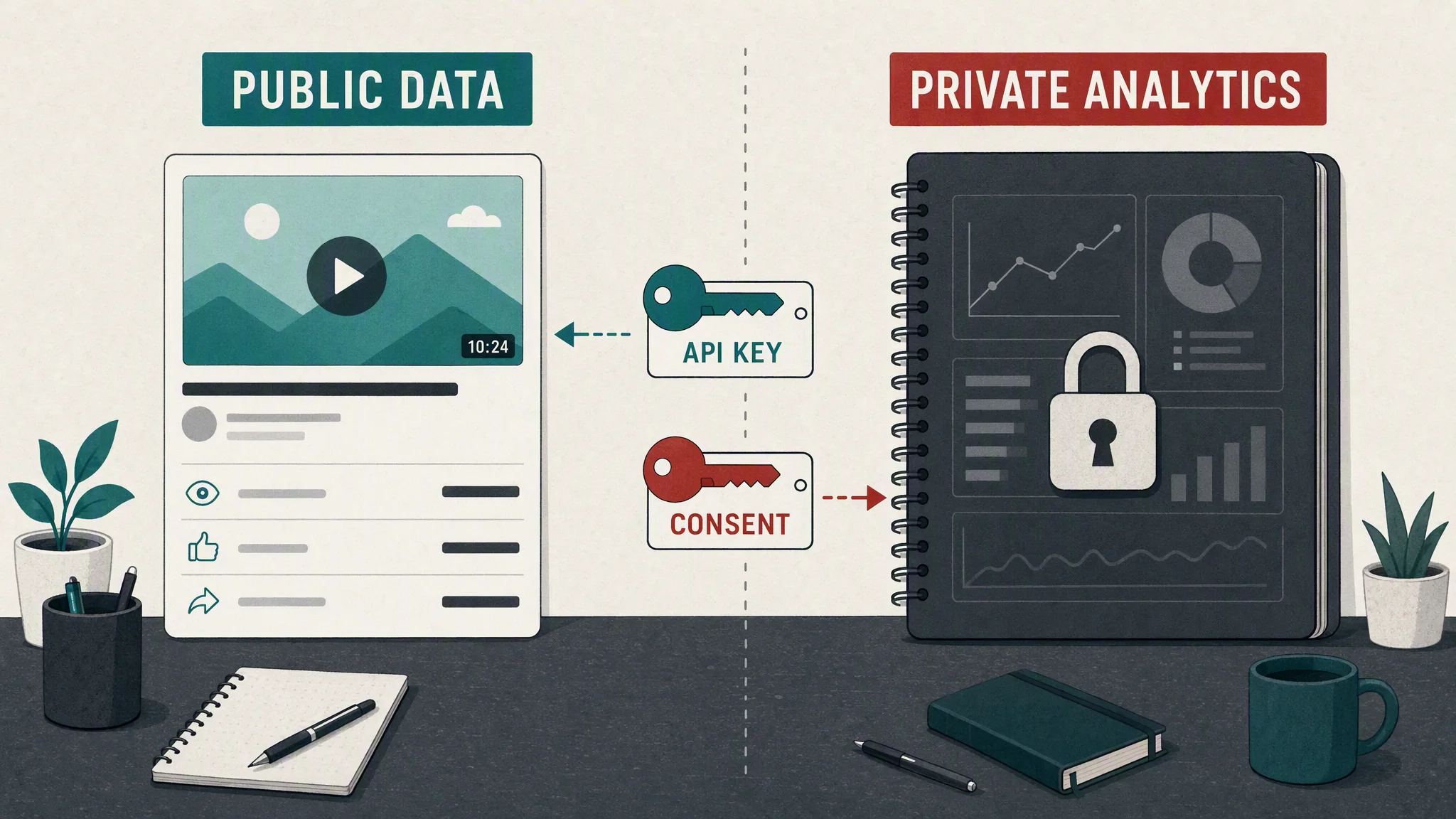
An API key identifies the Google Cloud project making a request. It does not prove that the project owns a YouTube channel, and it does not open a creator's private account. That is why this site can show public video facts without asking a visitor to sign in, but cannot show Studio analytics.
Public fields available without channel authorization
For a public video, the YouTube Data API can return its title, channel attribution, publication time, duration, thumbnail resources, public live state, and public statistics when those fields are available. Public channel resources can also include names, images, subscriber visibility, upload playlists, and aggregate counts.
YTThumbFetcher uses a small subset for the factual reference card. It displays counts as values supplied by the API and does not rename them as a score.
Private metrics require OAuth
Impressions, click-through rate, audience retention, traffic sources, watch time, revenue, and audience demographics belong to YouTube Analytics or Reporting APIs. Those services require authorization from the relevant channel or content owner. More quota does not replace that consent.
Why facts and advice are separated
YouTube's developer policies distinguish API Data from information calculated by a third party. The interface labels public facts as "YouTube Data API" and labels the visual report as an independent YTThumbFetcher review. The AI model sees only the image URL.
Storage and refresh
Video API responses are cached for six hours to reduce quota use and latency. This is far shorter than the 30-day policy boundary for non-authorized statistics. AI reports expire after one day and are not used to build public profile pages.
Derived metrics
YouTube introduced additional terms for approved analytics use cases in 2026. Unless a developer has accepted and qualified for those terms, API data should not be turned into custom engagement rates, momentum scores, leaderboards, or performance predictions. YTThumbFetcher keeps derived metrics disabled.
Quota behavior
The site extracts a video ID locally and uses a direct list request instead of search. It caches successful metadata at Cloudflare's edge. If YouTube metadata is temporarily unavailable, the tool checks a fixed set of public thumbnail paths and labels the result as thumbnail-only mode.